
Configuring scale barcodes in Odoo 15 is essential for businesses that sell by weight, such as butcher shops, fruit shops and bulk food stores. If you sell fruit by the kilo, for example, each weighed product needs an automatically generated barcode containing its price or quantity. This speeds up sales and avoids calculation errors. This article explains how to configure barcode scales in Odoo 15 for more accurate and faster sales of products by weight.
Open Point of Sale and go to settings.
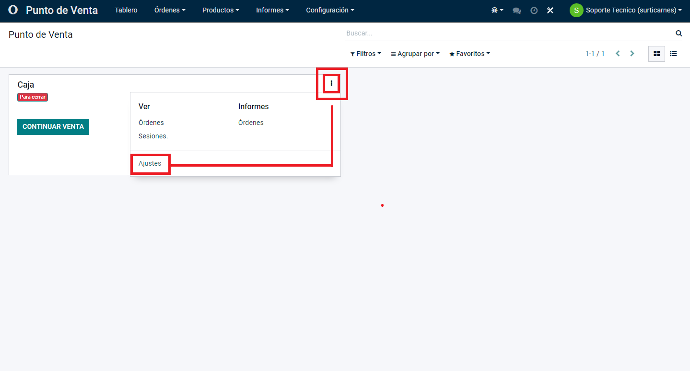
Go to "Connected Devices" and click the arrow for "Barcode Nomenclature".
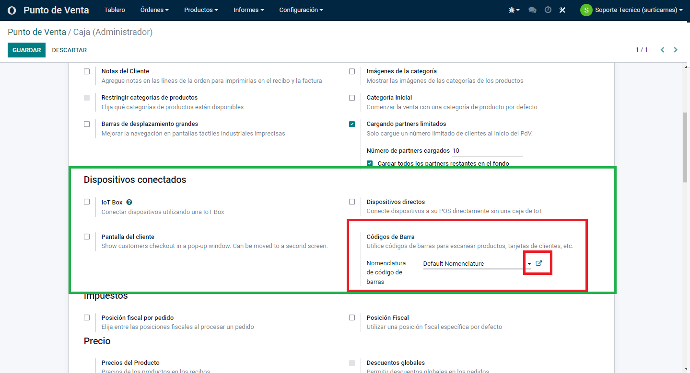
First, check that "UPC/EAN Conversion" is set to "Always". Then click the weighted product item.
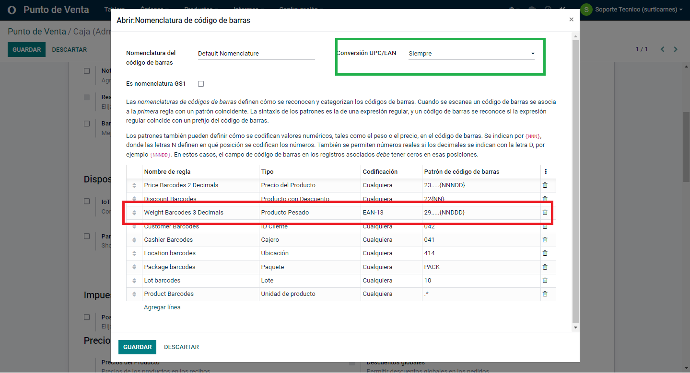
Following the software's instructions, change the first two digits of the weighted product barcode using the nomenclature generated by the label printer.
The nomenclature uses the {NNN} structure, where N indicates a position encoding a number. Real numbers are also allowed when decimal positions are indicated with D, for example {NNNDD}. Enter zeros in those positions in the barcode field of the associated records.
Using the weighted product barcode in the example (2900012012507), "29" is the prefix and the other 5 digits (01250) represent the whole number and the product's three decimal places:
Applying the nomenclature with the {NNN} structure gives the new barcode: {290}0012012507.
Follow the software's specific instructions and enter the required zeros in the barcode field of the associated records.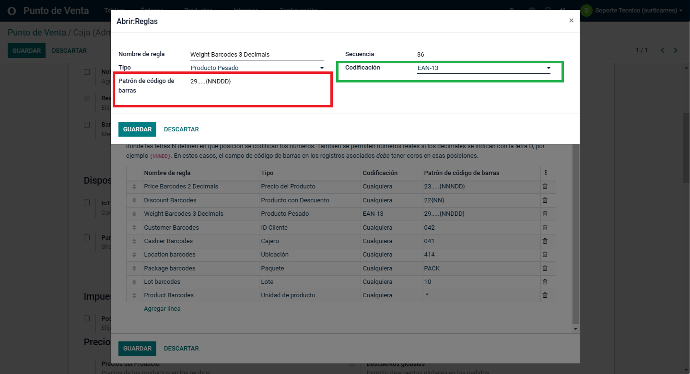
After configuring barcode nomenclature and generation, return to the product and assign its barcode. In the example (2900002000009), "29" is the code generated by the scale, "00002" is the product code, "00000" is reserved for the weight and "9" is the check digit:
The complete barcode is: 2900002000009.
Enter this barcode correctly on the product, keeping "00000" in the space reserved for weight and including the check digit "9".
Each system or application may have its own specific rules and settings. Follow the instructions for the software you use to generate and assign barcodes correctly.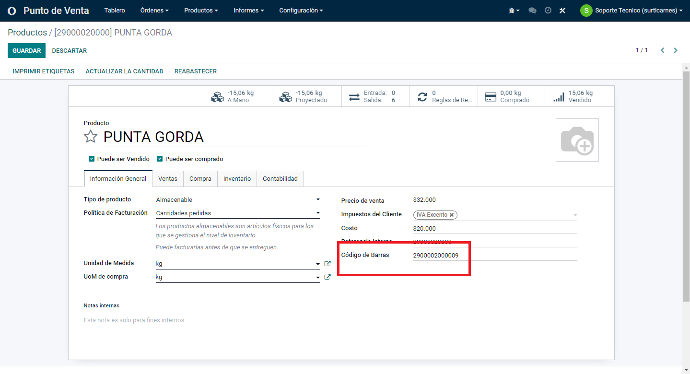
To calculate the check digit for an EAN-13 or GTIN-13 barcode, you can use a page such as "https://www.codigos-qr.com/calcular-digito-de-control-ean13-gtin13/". Enter the code's 12 digits there to obtain the check digit that completes the barcode.
Using the example code (290000200000), enter those 12 digits on the page mentioned above to obtain the check digit needed to complete the barcode.
Once you have the check digit, add it to the original code. For example, if the check digit is "5", the full barcode is: 2900002000005.
Always check the calculations and use reliable tools to ensure the check digit is accurate.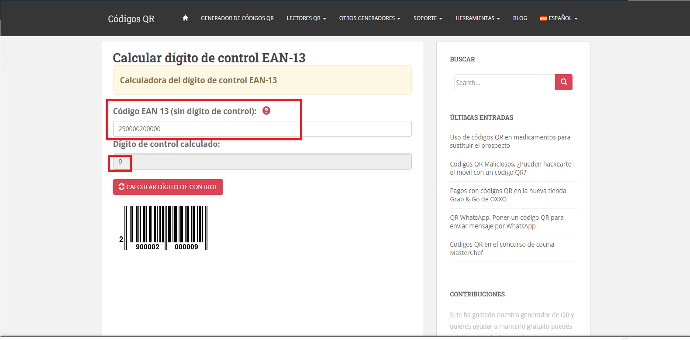
Go to the "Sales" tab and find the option to enable the "To Weigh With Scale" button. Once you have found it, click the button to enable it.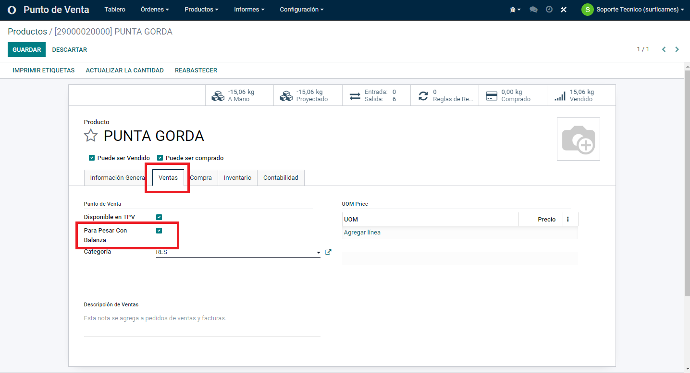
In Point of Sale, simply scan the barcode generated by the scale. Using the example mentioned earlier (barcode: 2900002022506), "29" is the scale code, "00002" is the product code, "02250" represents the weight (2.25 kg) with two decimal places, and "6" is the check digit:
When the barcode is scanned, Point of Sale automatically recognizes the data and uses the weight (2.25 kg) as product information. This lets you record and process the item's sale with the correct weight.
Make sure the scanner is configured correctly and in barcode reading mode.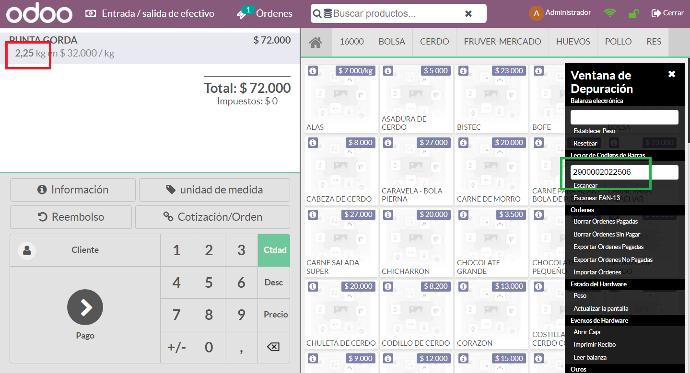
Configuring scale barcodes in Odoo 15 is crucial for businesses handling bulk products or products sold by weight. For example, if you run a butcher shop, you can automatically generate barcodes reflecting the exact weight of the meat sold, making transactions easier and reducing register errors. This configuration helps improve your workflow and ensure prices are always correct. Implementing this system improves your customers' experience and makes sales more efficient and accurate. Improve your business with Odoo 15 and scale barcode integration!